How to Add, Subtract, Multiply & Divide Integers: A Step-by-Step Guide with Real-Life Examples, Worksheets & MCQs
Published: 16 Feb 2025
Welcome to our beginner’s guide on integer operations! As you have learned about “What are Integers?” Here you learn the rules for adding, subtracting, multiplying, and dividing integers with clear explanations and real-life examples. With free worksheets and MCQs for Grades 6-8, mastering integer operations has never been easier. Let’s start exploring!
Signs with Brackets: Positive & Negative
When dealing with integers, it’s important to understand the role of signs before brackets.
The sign before a bracket can change the entire expression. In this section, we’ll explore how positive and negative signs work with brackets to make your calculations clear and error-free.
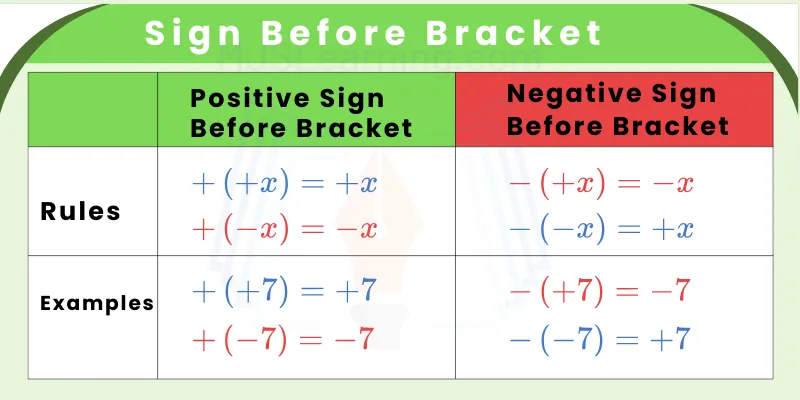
Positive sign before bracket
The positive sign before a bracket does not change the sign of the expression inside the bracket while solving it.
Rules:
- (+(+x) = +x)
- (+(-x) = -x)
Examples:
- ( +(+7)=+7=7 )
- ( +(-7)=-7 )
Negative sign before bracket
The negative sign before the bracket changes the sign of the expression inside the bracket while solving it.
Key Points:
- If an expression is positive, makes it negative.
- If an expression is negative, makes it positive.
Rules:
- (-(+x) = -x)
- (-(-x) = +x)
Examples:
- ( -(+7)=-7 )
- ( -(-7)=+7=7 )
Operations on Integers
Addition of Integers
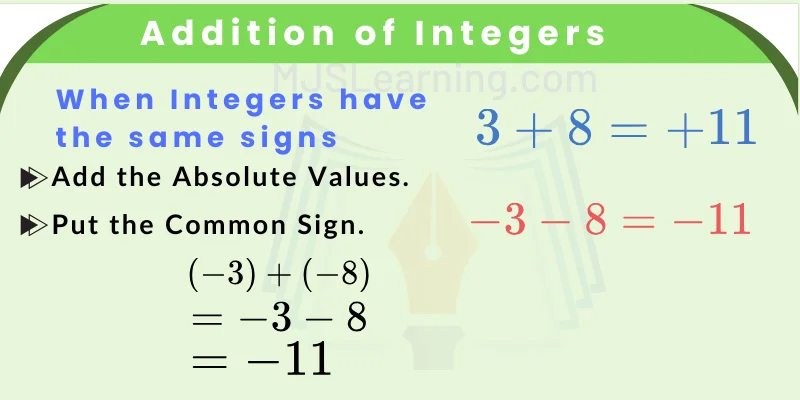
When integers have the same sign, follow these steps:
- Add the absolute values (ignore signs).
- Put the common sign.
Addition of Integers Examples:
- ( 3+8=11 )
As the common sign is (‘+’), the sum is (Positive). - ( -3-8=-11 )
As the common sign is (‘-‘), the sum is (Negative). - ( (+3)+(+8) )
( =+3+8 )
( =+11=11 ) - ( (-3)+(-8))
( =-3-8 )
( =-11 ) - ( (0)+(-15))
( =0-15 )
( =-15 )
Subtraction of Integers
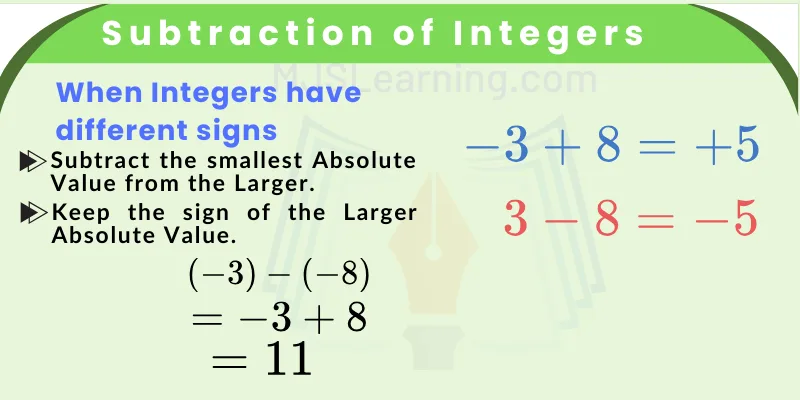
When integers have different signs, follow these steps:
- Subtract the smaller absolute value from the larger.
- Keep the sign of the larger absolute value.
Subtraction of Integers Examples:
- ( -3+8=+5 )
As the sign of greater value is (Positive), the result is (Positive). - ( 3-8=-5 )
As the sign of greater value is (Negative), the result is (Negative). - ( (+3)-(+8) )
( =+3-8 )
( =-5 ) - ( (-3)-(-8))
( =-3+8 )
( =+5=5 ) - ( (0)-(-15))
( =0+15 )
( =+15=15 )
- When we subtract two positive integers, if the 1st integer is greater then the answer will be positive.
- When we subtract two positive integers, if the 1st integer is smaller then the answer will be negative.
Multiplication of two Integers
To multiply two integers, follow these steps:
- Multiply the absolute values of the integers.
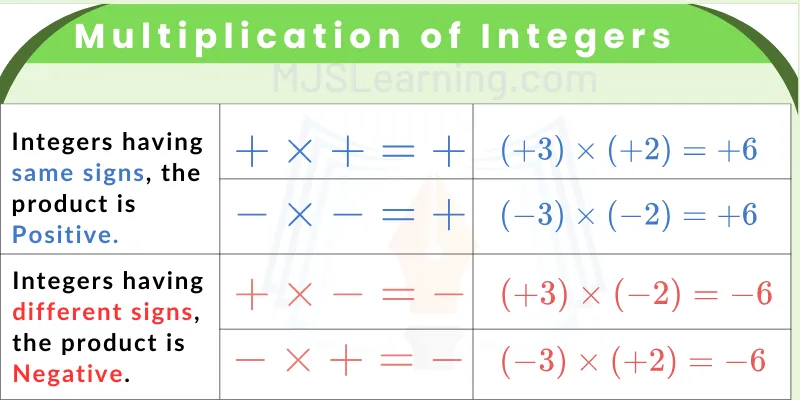
- Integers having same signs, the product is positive.
- Integers having different signs, the product is negative.
- ( + times + = +)
- ( – times – = +)
- ( + times – = -)
- ( – times + = -)
Examples of Multiplying Integers: Step-by-Step Guide:
- ( (+3) times(+8) )
( =+24=24 )
As both Integers have same signs, the result is (Positive). - ( (-3) times(-8) )
( =+24=24 )
As both Integers have same signs, the result is (Positive). - ( (+3) times(-8) )
( =-24 )
As both Integers have different signs, the result is (Negative). - ( (-3) times(+8) )
( =-24 )
As both Integers have different signs, the result is (Negative).
- Multiplying even number of integers with the same sign always gives a positive product.
Example:
( (+4) times (+3) times (+2) times (+1) = +24 )
( (-2) times (-2) times (-2) times (-2) = +16 ) - Multiplying even number of integers with the negative sign always gives a positive product.
Example:
( (-2) times (-2) = +4 )
( (-2) times (-2) times (-2) times (-2) = +16 ) - Multiplying odd number of integers with the negative sign always gives a negative product.
Example:
( (-2) times (-2) times (-2) = -8 )
( (-2) times (-1) times (-3) times (-2) times (-1) = -24 )
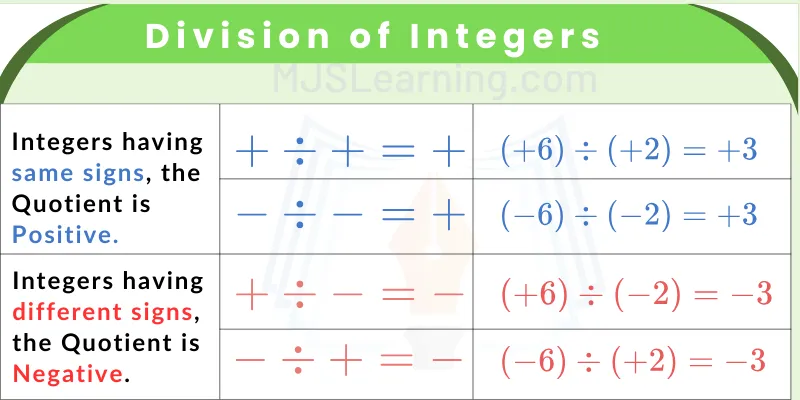
Division of two Integers
To divide two integers, follow these steps:
- Divide the absolute value by another value.
- Integers having the same signs, the quotient is positive.
- Integers having different signs, the quotient is negative.
- ( + div + = +)
- ( – div – = +)
- ( + div – = -)
- ( – div + = -)
Examples of Dividing Integers: Step-by-Step Guide:
- ((+45) div (+5) )
( =+9=9 )
As both have same signs, the result is (Positive). - ((-45) div (-5) )
( =+9=9 )
As both have same signs, the result is (Positive). - ((+45) div (-5) )
( =-9 )
As both have different signs, the result is (Negative). - ( (-45) div (+5) )
( =-9 )
As both have different signs, so the result is (Negative).
- When zero is divided by any integer, the result is always zero ((0)).
Example: (frac{0}{5} = 0) - When any integer is divided by (0), the division is not possible, and the result is undefined ((infty)).
Example: (frac{5}{0}) is undefined. - (frac{9}{5}) is a rational number.
Example: (frac{9}{5} = 1.8), which is a ratio of two integers.

How to Compare and Order Integers: A Step-by-Step Guide with Examples, Worksheets & MCQs

- Be Respectful
- Stay Relevant
- Stay Positive
- True Feedback
- Encourage Discussion
- Avoid Spamming
- No Fake News
- Don't Copy-Paste
- No Personal Attacks
- Be Respectful
- Stay Relevant
- Stay Positive
- True Feedback
- Encourage Discussion
- Avoid Spamming
- No Fake News
- Don't Copy-Paste
- No Personal Attacks
