Understanding Integer Properties: A Beginner’s Guide with Real-Life Examples, Worksheets & MCQs
Published: 16 Feb 2025
Confused 🤔about integer rules ? Don’t worry 😥, you’re not alone! This easy guide explains the basic Properties of Integers—like closure, commutative, associative, and distributive—in simple steps with real-life examples. You can also practice with free downloadable worksheets and interactive MCQs designed specifically for Grades 6-8. Let’s turn confusion into clear understanding—ready to get started?🚀
Properties of Integers
🤔Properties of integers are the basic rules that show how numbers work together. For example, adding two integers always gives another integer—this is known as the closure property. Other simple rules, like the commutative, associative, and distributive properties, help keep math predictable and easy to understand.
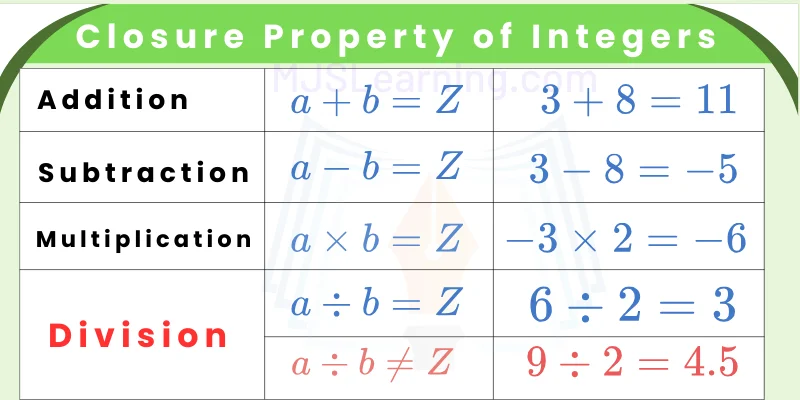
Closure Property of Integers
- Closure Property of Addition
The sum of integers is always an integer.
Statement:
( a+b=Z )
Example:
( 3+8=11 )
Where ( 11 ) is an Integer. - Closure Property of Subtraction
The difference of integers is always an integer.
Statement:
( a-b={ Z } )
Example:
( 3-8=-5 { (Z) } ) - Closure Property of Multiplication
The product of integers is always an integer.
Statement:
( a times b= { Z } )
Example:
( 3 times 8=24 (Z) )
( -3 times 8=-24 { (Z) } ) - Closure Property of Division
The division of two integers may or may not be an integer.
Statement:
( a div b= Z ) (Exactly divisible)
( a div b neq Z ) (Not exactly divisible)
Example:
( -12 div 4=-3 { (Z) } )
( 9 div 2=4.5 (Not an Integer) )
Commutative Property of Integers
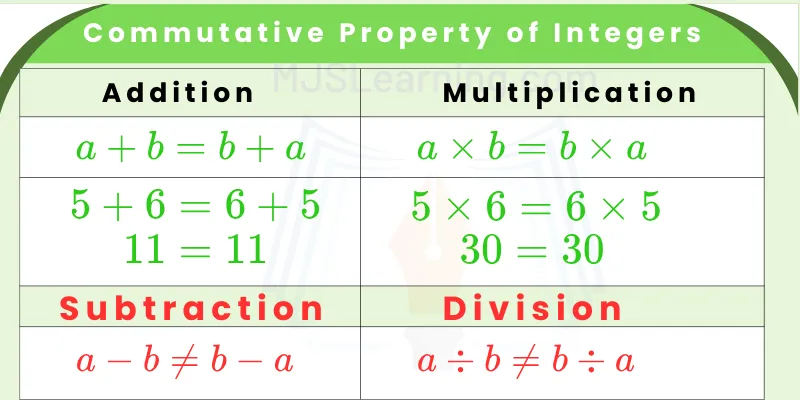
- Commutative Property of Addition:
When we change the position or order of two integers in addition does not change the final result.
Statement:
If ( a, b in Z ) then ( a+b= b+a)
Example:
( -7+9=9+(-7) )
( -7+9=9-7 )
( 2=2 ) - Commutative Property of Multiplication
When we change the position or order of two integers in multiplication does not change the final result.
Statement:
If ( a, b in Z ) then ( a . b= b.a )
Example:
( 7 times 9=9 times 7 )
( 63=63 )
Commutative Property of Subtraction and Division may not be applicable.
Examples:
3. Commutative Property of Subtraction
( 7-9=9-7 )
( -2 neq 2 )
4. Commutative Property of Division
(frac{6}{3} neq frac{3}{6} )
( 2 neq 0.5 )
Associative Property of Integers
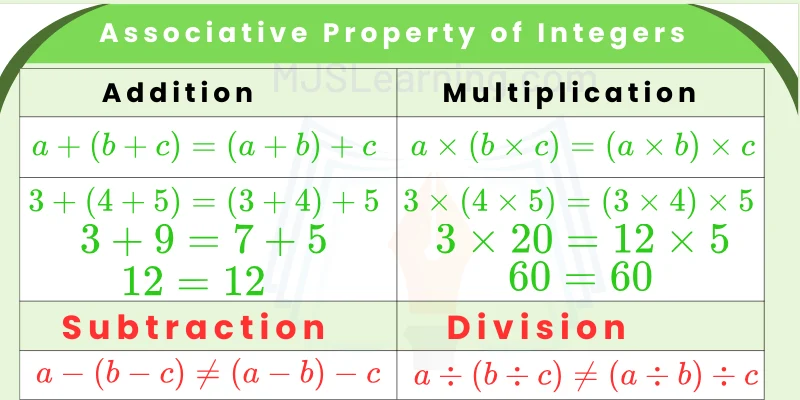
- Associative Property of Addition:
The order of grouping the integers in different ways in Adding does not affect the final result.
Statement:
If ( a, b, c in Z ) then
( a+(b+c)=(a+b)+c )
Example:
( 3+(4+5) =(3+4)+5 )
( 3+9 =7+5 )
( 12 =12 ) - Associative Property of Multiplication
The order of grouping the integers in different ways in Multiplying does not affect the final result.
Statement:
If ( a, b, c in Z ) then
( a(b c)=(a b) c )
OR
( a times(b times c)=(a times b) times c )
Example:
( 3 times(4 times 5)=(3 times 4) times 5 )
( 3 times 20=12 times 5 )
( 60=60 )
Associative Property of Subtraction and Division may not be applicable.
Examples:
3. Associative Property of Subtraction
( 2-(3-5) =(2-3)-5 )
( 2-(-2) =(-1)-5 )
( 2+2 =-1-5 )
( 4 neq-6 )
4. Associative Property of Division
( 2 div(3 div 5)=(2 div 3) div 5 )
( 2 div 0.6=0.66 div 5 )
( 3.333 ldots neq 0.132 )
Distributive Property of Integers
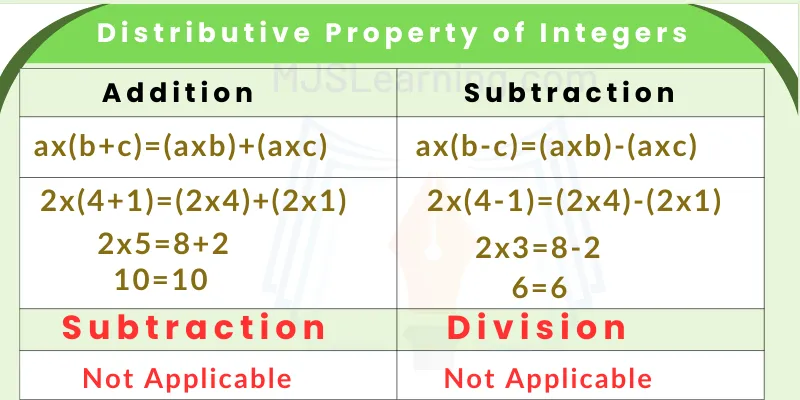
- Distributive Property over Addition:
The distributive property of integers over addition states that multiplying an integer by the sum of two integers is the same as multiplying the integers separately and then adding the products.
Statement:
( a times(b+c)=(a times b)+(a times c) )
Example:
( 2 times(4+1)=(2 times 4)+(2 times 1) )
( 2 times 5=8+2 )
( 10=10 ) - Distributive Property over Subtraction:
The distributive property of integers over subtraction states that multiplying an integer by the difference of two integers is same as multiplying the integers separately and then subtracting the products.
Statement:
( a times(b-c)=(a times b)-(a times c) )
Example:
( 2 times(4-1)= (2 times 4)-(2 times 1) )
( 2 times 3=8-2 )
( 6=6 )
Additive Identity
Zero (0) is called Additive Identity because adding “0” to any integer does not change that integer.
Statement:
( a+0=0+a=a )
Examples:
- ( 3+0=0+3=3 )
If we add (3) and (0), we get (3). - ( -5+0=-5 )
- ( 9+0=9 )
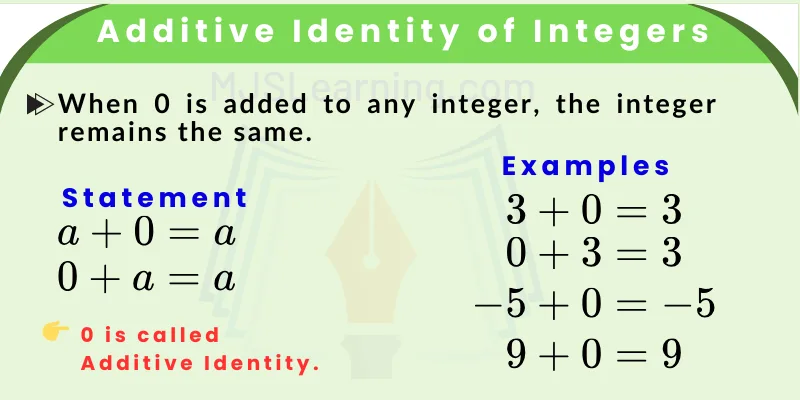
When any integer is added to or subtracted from $0$, the result is the integer itself.
Examples:
- (a + 0 = a)
- (a – 0 = a)
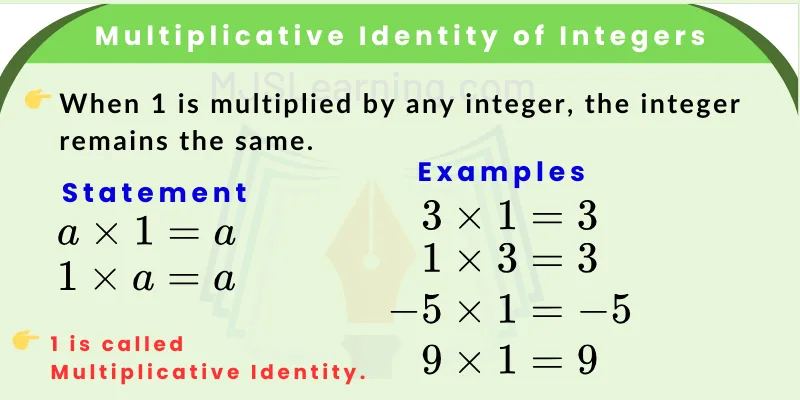
Multiplicative Identity
1 is called Multiplicative Identity because multiplying “1” to any integer does not change that integer.
Statement:
( a times 1=1 times a=a )
Examples:
- ( 3 times 1=1 times 3=3 )
If we add (3) and (0), we get (3). - ( -5 times 1=-5 )
- ( 9 times 1=9 )
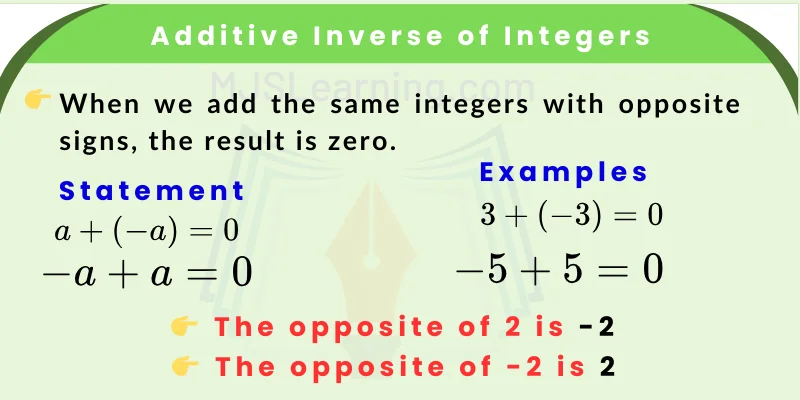
- The opposite of (2) is (-2).
- The opposite of (-2) is (2).
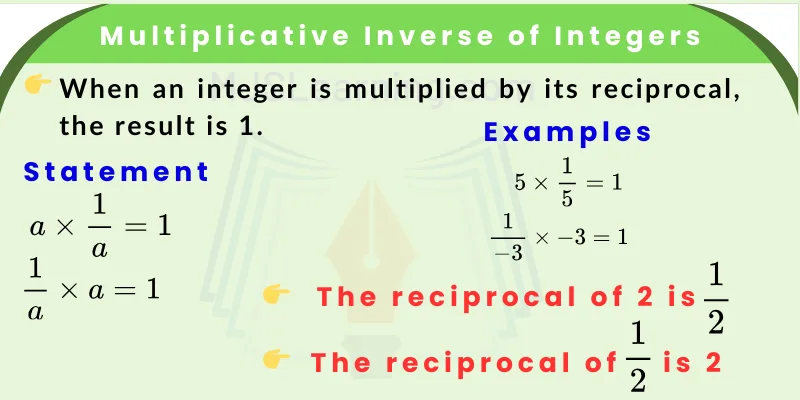
- The reciprocal of (3) is (frac{1}{3}).
- The reciprocal of (frac{1}{3}) is (3).
Additive Inverse
If we add an integer to its opposite integer, the result will always be zero $(0)$.
If ( a in Integer ) then ( a+a^{prime}= a^{prime}+a=0) then ( a^{prime} ) is called additive inverse of ( a )
Statement:
( a+(-a)=-a+a=0 )
( 10+(-10)=-10+10=0 )
Examples:
- ( 3+(-3)=0 )
- ( -5+5=5-5=0 )
- ( -20+20=0 )
- ( 10-10=0 )
- ( a+(-a)=0 )
Multiplicative Inverse
If we multiply an integer to its reciprocal integer, the result will always be $“1”$.
If ( a in Integr ) then ( a cdot a^{-1}= a^{-1} cdot a=1 ) then ( a^{-1} ) is called multiplicative inverse of ( a ) .
Statement:
( a cdot frac{1}{a}=frac{1}{a} cdot a=1 )
( 10. frac{1}{10}=frac{1}{10} cdot 10=1 )
Examples:
- ( 5 . frac{1}{5}=1 )
- ( -3 times frac{1}{-3}=1 )
- ( -3left(frac{1}{-3}right)=1 )

How to Add, Subtract, Multiply & Divide Integers: A Step-by-Step Guide with Real-Life Examples, Worksheets & MCQs

- Be Respectful
- Stay Relevant
- Stay Positive
- True Feedback
- Encourage Discussion
- Avoid Spamming
- No Fake News
- Don't Copy-Paste
- No Personal Attacks
- Be Respectful
- Stay Relevant
- Stay Positive
- True Feedback
- Encourage Discussion
- Avoid Spamming
- No Fake News
- Don't Copy-Paste
- No Personal Attacks
